
A Crude Awakening:
How Oil Prices Ripple Through the Global Economy
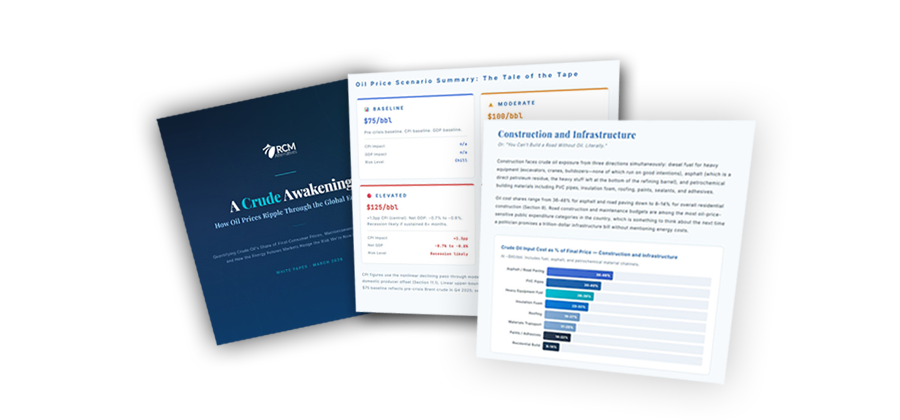
Most people think oil only shows up at the gas pump. The reality? It’s embedded in thousands of products and services, fueling transportation, manufacturing, agriculture, and global trade.
In today’s environment of geopolitical tension and market volatility, understanding oil’s true economic impact isn’t optional, it’s essential.
In this in-depth whitepaper, we break down:
- Where oil shows up in everyday prices (from food to flights to consumer goods)
- How rising oil prices impact inflation and GDP across multiple economic scenarios
- What happens at $100, $125, and $150 oil, and why it matters
- The hidden supply chain effects most investors overlook
- How businesses are using futures markets to hedge risk, and who’s exposed
Built on data from leading economic sources and real-world market activity, this analysis goes beyond headlines to quantify what rising oil prices actually mean, for investors, businesses, and the broader economy.
Download the full whitepaper to access the complete analysis and scenario breakdown →
©2026 RCM Alternatives, Licensed Managed Futures, Trading System & Commodity Brokers. All Rights Reserved. Legal & Disclaimers | Privacy Policy
IMPORTANT RISK DISCLOSURE
The risk of loss in trading commodity futures contracts, whether on one's own or through a managed account or pooled ‘fund’, can be substantial. You should therefore carefully consider whether such trading is suitable for you in light of your financial condition. You may sustain a total loss of the initial margin funds and any additional funds that you deposit with your broker to establish or maintain a position in the commodity futures market . Any specific investment or investment service contained or referred to in this website is intended for accredited investors only and is not suitable for all investors. You should not rely on any of the information as a substitute for the exercise of your own skill and judgment in making such a decision on the appropriateness of such investments. Finally, the ability to withstand losses and to adhere to a particular trading program or fund in spite of trading losses are material points which can adversely affect investor performance. Past performance is not necessarily indicative of future results.